Macrophage Polarization
How tissue needs shape immune responses
Explore how macrophages switch between anti-inflammatory and pro-inflammatory states, driven by the NOD2 receptor.
A CDI Interactive experience by CDI StudioUpdated
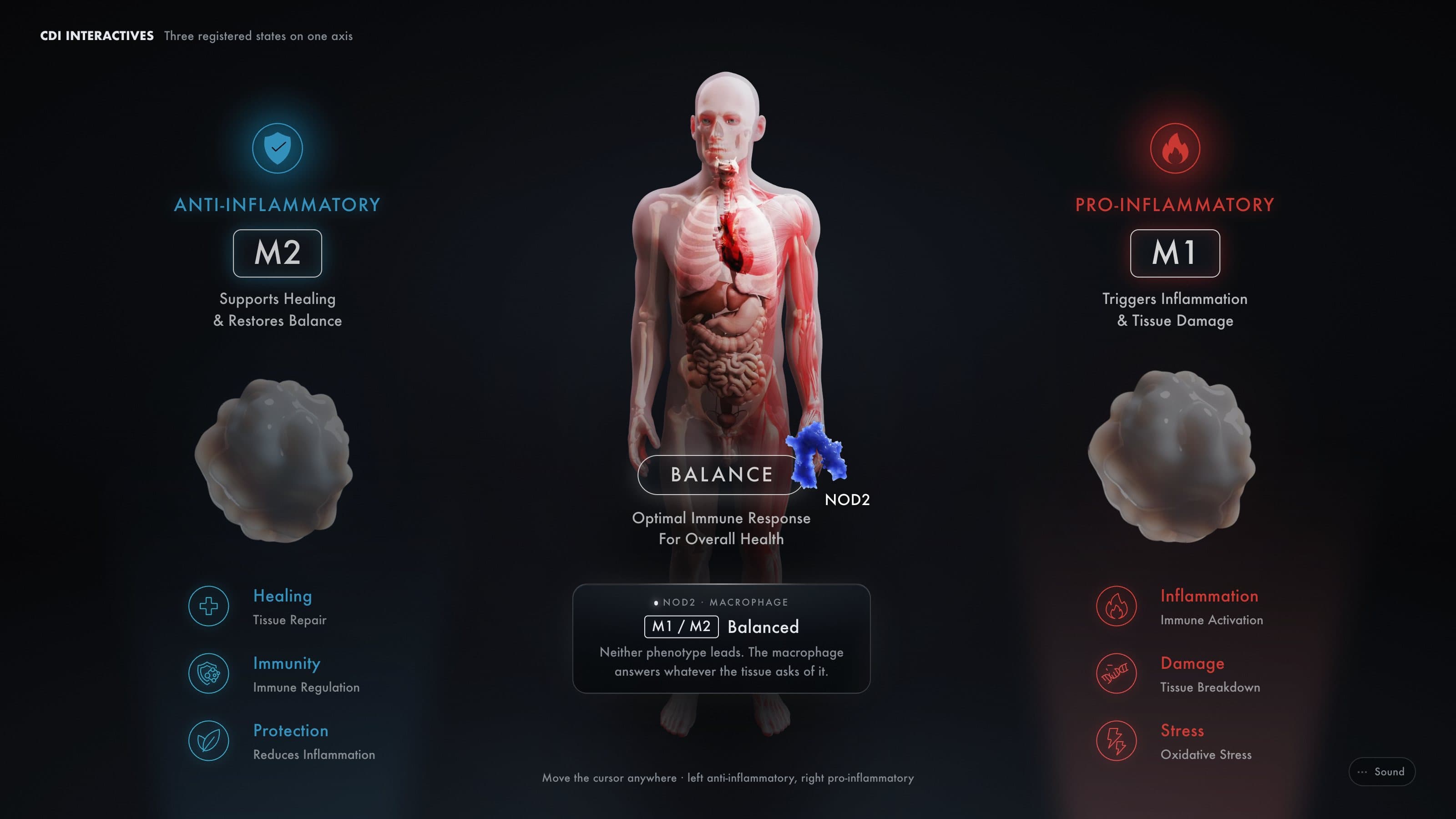
It runs in its own tab so it gets the whole screen, the sound and the full frame rate. Move and click anywhere inside it.
Overview
A macrophage is not fixed. It adapts. When tissue is injured, it sends signals asking for inflammation and cleanup. When infection is controlled, it asks for healing. The same macrophage can respond to both calls by shifting its state, called polarization. This shift changes what the cell produces, how it behaves, and what outcome it drives. This interactive shows you that spectrum in real time.
Macrophage polarization happens along a continuum. On one end lies M2: the repair and healing state, marked by anti-inflammatory molecules and tissue rebuilding. On the other end lies M1: the fighting state, producing pro-inflammatory factors and toxic molecules to kill pathogens or tumor cells. Most macrophages live somewhere in between, responding to whatever their tissue needs. The key driver of this balance is the NOD2 receptor, a pattern-recognition protein that listens to microbial signals and tissue cues.
Understanding polarization matters because it shapes outcomes in infection, cancer, autoimmune disease, and chronic inflammation. Drugs that nudge macrophages toward M2 can reduce harmful inflammation. Drugs that push toward M1 can boost anti-tumor immunity. The wrong nudge at the wrong time can backfire. This is why mechanism matters.
The Science
The NOD2 receptor sits inside the cell and detects a specific bacterial pattern: peptidoglycan. When NOD2 senses this signal, it activates a cascade that ripples through the cell. Depending on what other signals are present, this cascade can tip the macrophage toward M1 (pro-inflammatory) or be dampened by anti-inflammatory signals like IL-10, pushing the cell toward M2. The outcome is not hardwired. It is conditional.
M2 macrophages produce IL-10, TGF-beta, and arginase. These molecules suppress inflammation and promote healing. They help resolve infection, repair tissue, control autoimmunity, and promote tumor tolerance. M1 macrophages produce TNF-alpha, IL-12, IL-6, and reactive oxygen species. These drive inflammation, kill intracellular pathogens, and attack tumor cells. They also cause collateral damage to healthy tissue if the fight goes too long.
The NOD2 mutation found in Crohn's disease weakens the ability to sense bacteria, disrupting the balance. Some patients tilt too far toward M1 and suffer chronic inflammation. Others dysregulate entirely and lose the ability to mount a proper response. Cancer cells exploit macrophage polarization by secreting factors that drive M2 states, creating an immunosuppressive tumor microenvironment. Drugs that modulate NOD2, directly or downstream, can restore balance.
How to Interact
Move your cursor left and right across the screen to shift the macrophage state in real time. Watch the cell morph, the color gradient shift from blue to red, and the molecular outputs change. The left side shows M2: cooler tones, healing markers, and a quieter inflammatory profile. The center is balance: the cell poised to respond flexibly. The right side shows M1: hot tones, aggressive cytokine production, and oxidative stress.
As you move, listen to the soundscape shift with the cell state. Each state has its own audio signature, reinforcing the sense of a living system responding to your input. The colors are not arbitrary. Blue is calm, M2, repair. Red is active, M1, fighting. This color language mirrors clinical and research contexts where M1 and M2 are often plotted on a spectrum from left to right.
Take your time. Move slowly back and forth. Notice how the cell does not snap between states but morphs smoothly. This reflects biological reality: macrophage polarization is a spectrum, not a switch. Your tissue is always asking, and the macrophage is always listening.
Clinical Relevance
Macrophage polarization shapes outcomes in four major clinical areas. In autoimmune and chronic inflammatory diseases like Crohn's disease, rheumatoid arthritis, and lupus, the balance tips too far toward M1, driving sustained tissue damage. Therapies that encourage M2 or suppress M1 can reduce flares and improve remission rates. In cancer immunotherapy, the goal is often to flip tumor-associated macrophages from M2 (tumor-friendly) to M1 (tumor-fighting) to unlock anti-tumor immunity. In acute infection, M1 macrophages are essential for pathogen control, but if they overstay, they drive sepsis and organ failure. In wound healing and tissue repair, M2 macrophages orchestrate the rebuilding phase.
Drug developers now design molecules that modulate NOD2 signaling or target downstream pathways to tip the balance. Agonists amplify NOD2 sensing and can restore immunity in immunodeficiency. Antagonists dial down the signal in overactive inflammatory states. Because macrophage polarization is central to so many diseases, it has become a high-value target for mechanism-based drug design. The better you understand the system, the better you can predict side effects and synergies.
Frequently asked questions
What is the NOD2 receptor and why does it matter?
NOD2 is a pattern-recognition receptor inside cells that detects bacterial peptidoglycan. It acts as a molecular listener, triggering immune responses when bacteria are sensed. Mutations in NOD2 are linked to Crohn's disease and immunodeficiency because the cell cannot properly sense or respond to bacterial cues. Understanding NOD2 is essential for designing therapies that restore or fine-tune immune balance.
Can a macrophage switch back and forth between M1 and M2?
Yes. Macrophage polarization is reversible and dynamic. A macrophage that is M1 can become M2 if the tissue signals change, and vice versa. This plasticity is why polarization is not a fixed state but a spectrum. The cell adapts to what its tissue needs in that moment. This flexibility is also why drugs targeting macrophage polarization can work: you can nudge the balance toward a desired state.
How does macrophage polarization relate to cancer?
Tumors exploit macrophage plasticity by secreting factors that drive M2 polarization. These tumor-associated macrophages suppress anti-tumor immunity and promote tumor growth, angiogenesis, and metastasis. One strategy in cancer immunotherapy is to flip tumor-associated macrophages from M2 back to M1 to unlock anti-tumor killing. Another is to deplete them entirely. Understanding polarization is key to effective macrophage-targeted cancer therapies.
Ready to bring this to your team?
Macrophage polarization is complex. Let us show you how to explain it visually.
Schedule a Discovery CallInteractive animations are priced per scope. Average turnaround: 15-25 days.