Help T-Cell Find Cancer
Interactive exploration of immune surveillance and cancer detection
Guide T-cells through the body to detect and eliminate abnormal cells in this interactive immunotherapy game.
A CDI Interactive experience by CDI StudioUpdated
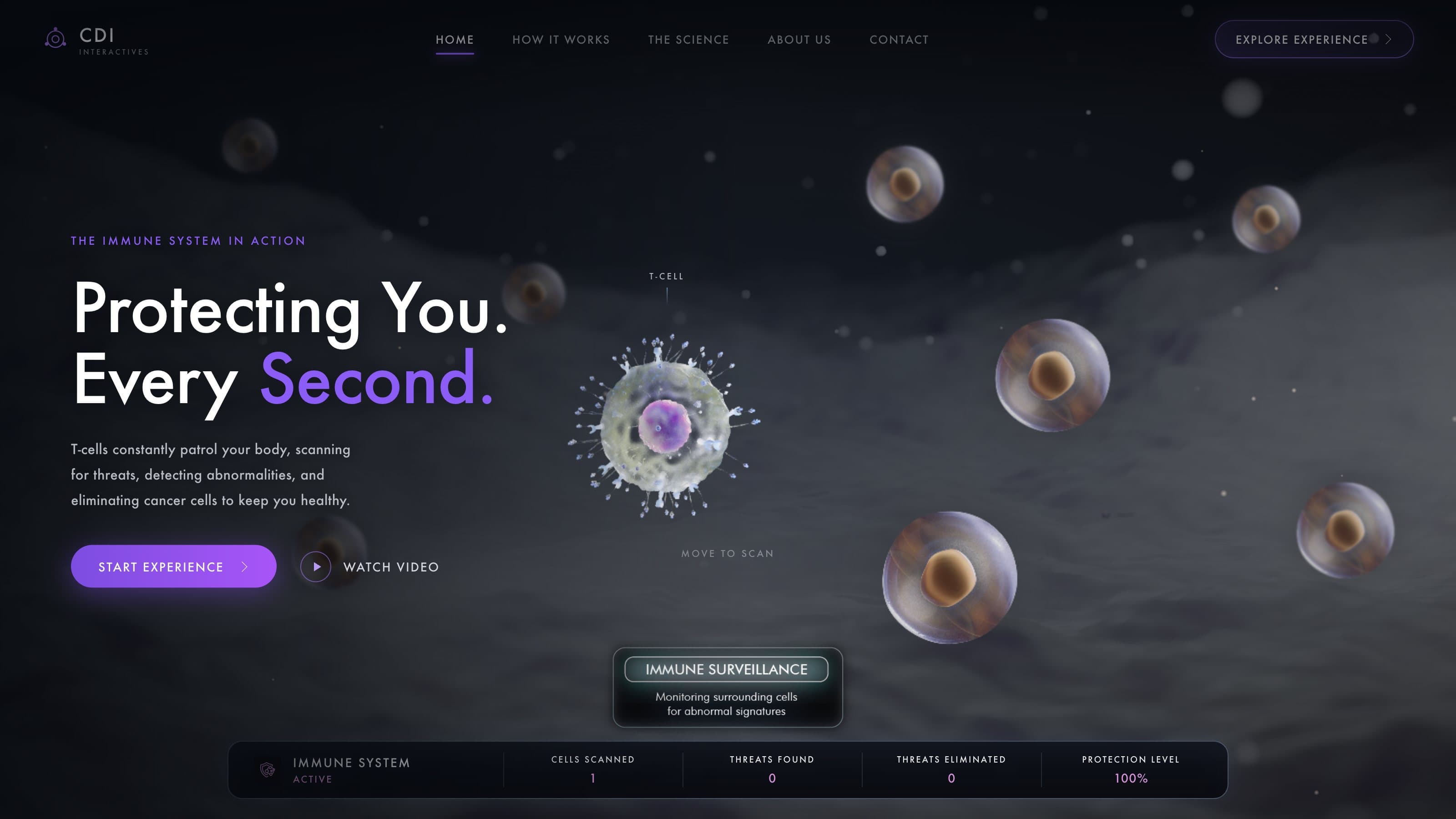
It runs in its own tab so it gets the whole screen, the sound and the full frame rate. Move and click anywhere inside it.
Overview
Your body has billions of patrol cells called T-cells. Right now, they are scanning your tissues, looking for anything out of place. When they spot an abnormal cell, they lock on and destroy it. This interactive experience lets you help guide a T-cell through the body's landscape, scanning cells and identifying the threats that your immune system catches every single day.
In this game, you move through a tissue environment, scanning nearby cells to check their ID signature. When a T-cell finds a match for a cancer cell, the hunt begins. You will see the real mechanics of immune surveillance, the same process that checkpoint-inhibitor drugs and CAR-T therapies enhance in the clinic.
The Science
T-cells recognize threats using T-cell receptors (TCRs), which are like ID scanners on the cell surface. Every cell in your body displays its ID on a molecule called MHC. Normal cells have normal IDs; cancer cells have broken or missing IDs that T-cells recognize as "wrong." When a T-cell finds the mismatch, it locks onto the cancer cell and releases toxins that destroy it.
Here's the problem: cancer cells evolve tricks to hide their broken ID or switch on a "don't attack me" flag called PD-L1. Checkpoint-inhibitor drugs block this brake. CAR-T therapy is even more direct: doctors take a patient's T-cells, reprogram them with an artificial TCR that hunts a specific cancer ID, then put millions of these custom T-cells back into the body to patrol and destroy.
How to Interact
Move your cursor or finger across the tissue to scan cells in the environment. As you hover over cells, the HUD at the top shows what you've scanned, how many threats you've found, and how many you've eliminated. Cells appear in different colors: normal cells are one color, cancer cells are another, and already-killed cells fade away.
When a T-cell detects a cancer cell's broken ID, click or tap to lock on and eliminate it. The more cancer cells you find and destroy, the better your immune system's performance score. The game shows you how this surveillance never stops, how many threats are caught and cleared, and why enhancing this process with therapy saves lives.
Clinical Relevance
Every year, millions of people benefit from immune therapies because their T-cells can now do their job better. Checkpoint inhibitors (like nivolumab and pembrolizumab) remove the cancer's "don't attack" signal. CAR-T cell therapy (like Kymriah and Yescarta) arms T-cells with new targeting abilities. Both rely on the exact mechanism you are exploring here: finding and eliminating cells that don't belong.
For biotech and pharma teams, this experience illustrates why immunotherapy works, how drugs fit into the immune process, and the real-world impact of getting the biology right. Understanding T-cell surveillance helps your team design better therapeutics, explain mechanisms to investors and regulators, and ultimately build treatments that give patients more time and better outcomes.
Frequently asked questions
What are T-cells and why do they matter?
T-cells are white blood cells that patrol your body, scanning tissues for abnormal or infected cells. They recognize threats by reading cell surface ID markers and destroy anything that looks wrong. Without T-cells, cancer and infections would overwhelm your body. Cancer immunotherapy works by unleashing or enhancing your T-cells to do their job better.
How does the immune system actually find cancer cells?
Cancer cells often have broken or altered ID signatures on their surface. T-cells constantly scan these signatures through their T-cell receptors (TCRs). When a T-cell detects a mismatch or abnormality, it locks onto the cancer cell and releases toxins to destroy it. Cancer tries to hide or disable this detection, which is why therapies like checkpoint inhibitors help T-cells break through the cancer's defenses.
What is CAR-T therapy and how is it different?
CAR-T therapy is a form of genetic engineering applied to immune cells. Doctors extract a patient's own T-cells, reprogram them with an artificial receptor (CAR) that targets a specific cancer cell ID, and then put millions of these enhanced T-cells back into the body. These custom T-cells are much better at finding and killing the target cancer. It's like giving your immune system a precision weapon instead of a general patrol force.
Ready to explore immune innovation?
Let's talk about bringing this story to your audience.
Book a Discovery CallInteractive animations are priced per scope. Average turnaround: 15-25 days.