
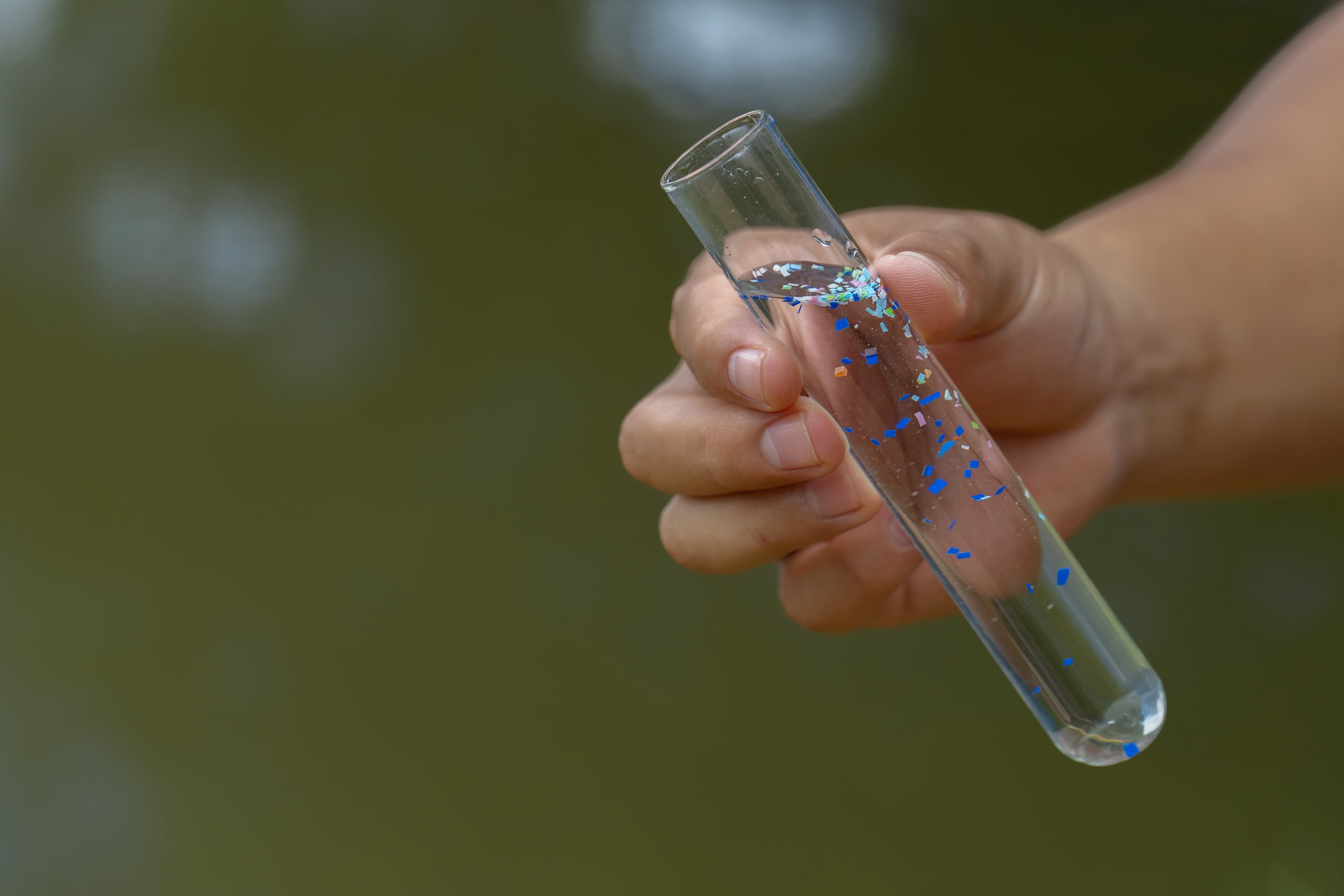
Plastic is everywhere. It keeps our food fresh, protects medicines, makes products lighter, and has become an everyday part of modern life.
However, this plastic does not simply go away when it breaks down.
Over time, larger plastic products can fragment into tiny particles known as microplastics. They have been found in water, food, air, and household dust—and increasingly, inside the human body.
That discovery has changed the conversation around plastic pollution. We are no longer asking only whether people are exposed to microplastics. We now know that exposure happens. The bigger question is what happens after these particles enter the body and whether repeated exposure could affect our health.
The research is still evolving, but some of the findings emerging in recent years are difficult to ignore.
What Are Microplastics?
Microplastics are plastic particles smaller than 5 millimetres. Some are large enough to see, while others are so tiny that specialised laboratory techniques are needed to detect them.
They generally come from two sources.
Primary microplastics are produced at small sizes for specific uses, while secondary microplastics form when larger plastic items break down through sunlight, heat, friction, and weathering.
Some particles can become even smaller and form nanoplastics, which are generally measured at less than 1 micrometre. Their extremely small size has attracted particular interest because they may interact with biological systems differently from larger particles.
How Do Microplastics Enter the Human Body?
There isn't just one route.
Microplastics can enter the body through food, drinking water, and the air we breathe. Household dust can contain plastic fibres released from synthetic clothing, carpets, furniture, and other materials. Food and drinks items may also come into contact with plastic during processing, packaging, storage, and preparation.
The amount a person encounters can vary considerably depending on their environment, lifestyle, diet, occupation, and other factors.
The World Health Organization has highlighted the need for further research into exposure and potential health effects, particularly because particle size, composition, additives, and exposure levels can all influence how microplastics behave.
Where Have Microplastics Been Found in the Human Body?
Over the past few years, researchers have detected microplastics presence in the human body including blood and tissues such as the placenta. More recent work has also identified plastic particles in human brain samples.
Finding a particle in an organ does not automatically mean it is causing harm. But these discoveries do show that exposure is not necessarily limited to plastic particles simply passing through the digestion.
Blood
A study of 2024 published in Scientific Reports detected microplastics in blood samples and examined their relationship with several biological markers.
The study found an association between higher microplastic levels and changes in markers related to blood coagulation and inflammation, including fibrinogen, C-reactive protein, and activated partial thromboplastin time.1
This does not prove that microplastics caused these changes, the study was relatively small and observational. However, the findings are noteworthy because changes involving blood clotting and inflammation can have implications for cardiovascular health.
Placenta
The placenta has also become an important area of attention.
One of the research studies noticed microplastics in human placental tissue, including within placental cells. They also observed shifts in some cellular structures, adding another layer to questions on how these fragments may interact with the placenta.2
Other recent research has likewise discerned microplastics in human placental samples. While these findings do not prove that microplastics cause pregnancy complications or affect fetal development yet, their presence in an organ responsible for supporting a developing baby is certainly something that deserves closer attention.
Brain
Perhaps the most attention-grabbing finding has been the detection of plastic particles in human brain tissue.
A 2025 study published in Nature Medicine observed micro- and nanoplastic material in human brain samples. The study also found higher concentrations in brain tissue than in the liver and kidneys examined.3
The findings are significant, but it needs to be interpreted carefully. Detecting plastic particles in brain tissue does not by itself prove that they crossed the blood-brain barrier or caused neurological disease.
Experimental studies have shown that a few tiny plastic particles can interact with and cross laboratory models of the blood-brain barrier (BBB), but lab findings cannot automatically be treated as evidence of what happens inside humans.
Still, the discovery of plastic particles in the human brain adds another important question to an already growing area of health research.
How Might Microplastics Affect Human Health?
Studies have reported several possible biological effects of microplastics, including inflammation, oxidative stress, immune responses, and changes in cellular function. Some research has also raised questions about hormonal effects and the chemicals that may be associated with plastic particles.
One reason this matters is that inflammation and oxidative stress can affect cells and tissues when they persist over time.
However, much of the evidence still comes from laboratory and animal studies, while human research is growing but remains limited. Exposure levels used in experiments may also differ from the amounts people normally encounter.
So the evidence does not allow us to say that everyday microplastic exposure directly causes a particular disease.
What it does tell us is that these particles are biologically active enough to deserve serious attention.
Why Is This Becoming a Health Concern?
The concern does not come from one dramatic discovery.
Rather, it comes from several pieces of evidence appearing together.
Microplastics are widespread. People encounter them through multiple routes. They have been detected in human blood and tissues, including the placenta and brain. Experimental studies have shown that some particles can interact with cells and biological barriers. And early human research has identified associations with biological markers related to inflammation and blood coagulation.
At the same time, important questions remain unanswered.
We still don't know exactly how much exposure is harmful, whether some types of plastic are more problematic than others, how long different particles remain in tissues, or what lifelong exposure might mean for health.
That uncertainty is important—but it should not be mistaken for either proof of safety or proof of harm.
It simply means we are still learning.
Can You Reduce Your Exposure?
Completely avoiding microplastics isn't realistic. But reducing unnecessary exposure is possible without changing your entire lifestyle.
A few simple habits may help:
Choose glass or stainless-steel containers when convenient, particularly for storing food and drinks.
Avoid unnecessarily heating food in plastic containers.
Reduce the use of single-use plastics where practical.
Keep indoor spaces clean and ventilated to help manage household dust.
Follow reliable local guidance on drinking water rather than assuming bottled water is automatically free of microplastics.
The goal isn't perfection.
It is simply making sensible choices where they are practical while science continues to develop.
The Bigger Picture
Microplastics are no longer just an environmental problem happening somewhere far away.
They are part of the world we live in, the products we use, and the exposure pathways we encounter every day. Their detection in human blood, placenta, and brain tissue has made them increasingly relevant to human health.
But this is also a subject where balance matters.
Some findings are concerning and deserve further investigation. Others come mainly from laboratory or animal studies and should not be presented as established human health effects.
The most honest conclusion is somewhere in the middle:
We know microplastics can enter the human body. We know they can reach different tissues. We have evidence that some particles can interact with biological systems. But we are still learning what this means for long-term human health.
That uncertainty is not a reason to ignore the issue.
It is a reason to keep asking better questions, improve the quality of research, and make practical choices that can reduce unnecessary exposure.
As the science continues to unfold, understanding microplastics may become an increasingly important part of understanding modern environmental health.
Visualizing the Invisible
Microplastics are difficult to explain because most of the particles discussed in research are far too small to see. Medical animation can help make these invisible processes easier to understand by showing how particles may enter the body, move through tissues, and interact with biological systems. When paired with evidence-based information, visual storytelling can make complex emerging health research easier for a wider audience to grasp.
References:
Lee DW, Jung J, Park S, Lee Y, Kim J, Han C, et al. Microplastic particles in human blood and their association with coagulation markers. Scientific Reports [Internet]. 2024 Dec 6 [cited 2026 Aug 8];14(1). Available from: https://www.nature.com/articles/s41598-024-81931-9
Ragusa A, Matta M, Cristiano L, Matassa R, Battaglione E, Svelato A, et al. Deeply in Plasticenta: Presence of Microplastics in the Intracellular Compartment of Human Placentas. International Journal of Environmental Research and Public Health. 2022 Sept 14;19(18):11593.
Nihart AJ, Garcia MA, El Hayek E, Liu R, Olewine M, Kingston JD, et al. Bioaccumulation of microplastics in decedent human brains. Nature Medicine [Internet]. 2025 Feb 3 [cited 2026 Aug 8];31(31). Available from: https://www.nature.com/articles/s41591-024-03453-1