
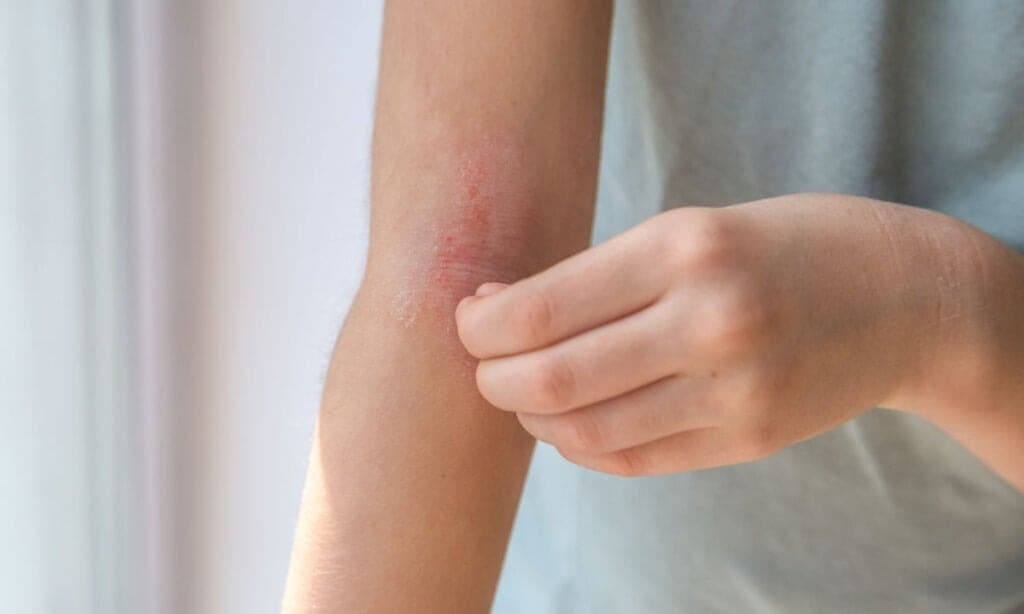
A patch of red, dry, itchy skin may look like a problem happening entirely on the surface. But with eczema, what you see is only part of the condition.
Beneath that irritated patch, the skin barrier may be struggling to hold on to moisture and protect the body from outside irritants. At the same time, immune activity can contribute to inflammation, making the skin increasingly sensitive and itchy.
That is why eczema is more than “just dry skin.”
Understanding what happens beneath the surface can help explain why eczema flares up, why the itching can become hard to ignore, and why protecting the skin barrier is such an important part of managing it.
Eczema Is More Than a Rash
Eczema is a generic term used for several inflammatory skin conditions. The most common type is called atopic dermatitis (AD) which is a chronic condition that often alternates between periods of flare-ups and quieter periods.
Common symptoms include dry or scaly skin, redness, irritation, and itching. Depending on the severity and stage of a flare, the skin may also become swollen, cracked, ooze, or thicken after repeated scratching.
But eczema does not have one simple cause.
Research describes atopic dermatitis as a condition involving several interacting factors, including problems with the skin barrier, immune responses, environmental influences, and changes in the skin’s microbial environment.
These factors also help to determine why eczema can appear and behave differently from one person to another.
Your Skin Barrier: The Part You Can’t See
Your skin does much more than only protect your body. Its outermost layers form a protective barrier that helps keep moisture intact while limiting the entry of unwanted substances.
In eczema-prone skin, this barrier may become less effective.
When the barrier is disrupted, the skin can lose moisture more easily and become dry and irritated. A weakened barrier can also make the skin more vulnerable to environmental irritants, hence may contribute to inflammation.
One review study discusses how inflammation and barrier disruption can reinforce one another and identifies a weakened permeability barrier as a characteristic of atopic dermatitis.1
This highlights an important aspect of eczema: the visible rash is only one part of the condition. Changes in the skin barrier can contribute to the problem even before the skin appears noticeably red or irritated.
What Happens During an Eczema Flare-Up?
An eczema flare is better understood as a chain reaction than as a single dermal problem.
When the skin barrier is already vulnerable, everyday exposures can further irritate it. Heat, sweating, friction, dry conditions, or certain skin-care products may aggravate symptoms in some people. Triggers are highly individual, however, and not everyone with eczema reacts to the same things.
As the skin becomes irritated, the immune response can lead to inflammation. The skin may then become red, dry, swollen, and intensely itchy.
Our short 3D eczema animation can help visualize what happens during a flare-up, including the relationship between the skin barrier, immune response, and the protective role of moisturizers.
Why Does Eczema Itch So Much?
Itch is one of the defining symptoms of atopic dermatitis, and it is not simply a consequence of having dry skin.
Research shows that eczema itch involves complex communication between the skin, immune system, and sensory nerves. This helps explain why the sensation can persist even when the visible rash does not seem particularly severe.2
And then there is the frustrating itch-scratch cycle.
You itch, so you scratch. Scratching may temporarily relieve the sensation, but repeated scratching can injure an already vulnerable epidermal barrier and cause further irritation. The damaged skin can then become even more sensitive, creating another reason to scratch.
This is also the reason that eczema is not merely a cosmetic skin condition. The persistent loop of itching can interfere with sleep, concentration, daily activities, and quality of life.
What Can Trigger an Eczema Flare?
There is no universal list of eczema triggers.
For some people, symptoms may worsen with dry or cold weather. For others, heat, sweating, friction, harsh cleansers, fragrances, or other irritants may play a role. Stress can also be associated with worsening symptoms for some individuals.
The important point is that a trigger does not necessarily cause eczema. It may instead aggravate skin that is already vulnerable.
That is why trying to eliminate every possible trigger can become frustrating. Paying attention to personal patterns is often more useful than assuming that one factor explains every flare.
What Actually Helps Protect Eczema-Prone Skin?
Once the role of the skin barrier is understood, one regular habit becomes easier to appreciate: moisturizing.
Moisturizers and emollients aid to reduce dryness and support the skin barrier. Current clinical guidelines recommend regular moisturizer usage as part of eczema care, including continued use after symptom relief.3
Gentle skin care matters too. Another 2024 guideline recommends regular emollient use and appropriate skin cleansing as part of basic care for atopic dermatitis.4
For active inflammation, moisturizers may not be enough on their own. Depending on the severity and location of eczema, healthcare professionals may recommend topical anti-inflammatory treatments or other therapies.
Treatment options have also expanded in recent years, giving clinicians more choices for people whose eczema is difficult to control. The appropriate treatment depends on factors such as age, severity, affected areas, symptoms, and previous treatment response.
Understanding Eczema Beyond the Surface
Eczema may appear as a red or itchy patch, but several factors can contribute to its development and persistence.
A vulnerable skin barrier, inflammatory response, sensory nerves, environmental exposures, and scratching can interact in ways that keep symptoms going.
That is why managing eczema is not simply about making a rash disappear. It involves calming inflammation, reducing itch, protecting the skin barrier, and understanding what may aggravate an individual’s symptoms.
Understanding these processes can make eczema less confusing and help explain why consistent skin-care habits are an important part of long-term management.
References:
Matthias Schmuth, Eckmann S, Moosbrugger-Martinz V, Ortner-Tobider D, Blunder S, Trafoier T, et al. Skin Barrier in Atopic Dermatitis. The journal of investigative dermatology/Journal of investigative dermatology. 2024 May 1;144(5):989–1000.e1.
Biazus Soares G, Hashimoto T, Yosipovitch G. Atopic Dermatitis Itch: Scratching for an Explanation. Journal of Investigative Dermatology [Internet]. 2024 May [cited 2026 Sept 19];144(5):978–88. Available from: https://www.jidonline.org/article/S0022-202X%2824%2900091-5/fulltext
Saeki H, Ohya Y, Arakawa H, Ichiyama S, Katsunuma T, Katoh N, et al. English version of clinical practice guidelines for the management of atopic dermatitis 2024. The Journal of Dermatology. 2024 Dec 20;52(2).
Werfel T, Heratizadeh A, Aberer W, Augustin M, Biedermann T, Bauer A, et al. S3 Guideline Atopic dermatitis: Part 1 ‐ General aspects, topical and non‐drug therapies, special patient groups. JDDG: Journal der Deutschen Dermatologischen Gesellschaft [Internet]. 2024 Jan [cited 2026 Sept 19];22(1):137–53. Available from: https://doi.org/10.1111/ddg.15230
Disclaimer:
This article is intended for educational and informational purposes only. It does not replace professional medical advice, diagnosis, or treatment. Readers should always consult a qualified healthcare professional regarding any medical concerns or conditions.